The Die-Cutting Process 

Die-cutting is super popular in terms of manufacturing and packaging. You may not know what die cutting is though, and let’s be honest, you’re probably not the only person with these questions. Here, we’ll go over the process, and what it means for your packaging as well. Die cutting is utilized to offer custom packaging that’s tailored to the experience that’s there, offering win-win situations for a lot of people. 

What Die IS 

Die is the first thing to understand. What is it? It’s basically a tool that’s specialized to shape and cut the materials that are used to package the items, and it uses a press to make this possible. Basically, this is a type of “mold” that shapes the way your packaging is cut out, and this is the first step that people are able to take. A die of course uses tools that makers will make to create a die that’s custom before it’s put on the press. You then finalize the die after the first batch of this is actually cut. 

Can you use these more than Once? 

Of course. This is something that actually costs a lot more if you don’t use it more than once. You only have to pay for the die one time, which is a lot cheaper than making a bunch of different die each time. The die for this is something that can be used a lot of times and it saves you a lot of money over time. 
Let’s say for example that you’ve got a bunch of products that have the same structure of packaging, but the artwork is a little different? The box only needs to have one die for this, so you’re saving a ton of money, especially with larger orders. 

The Process 

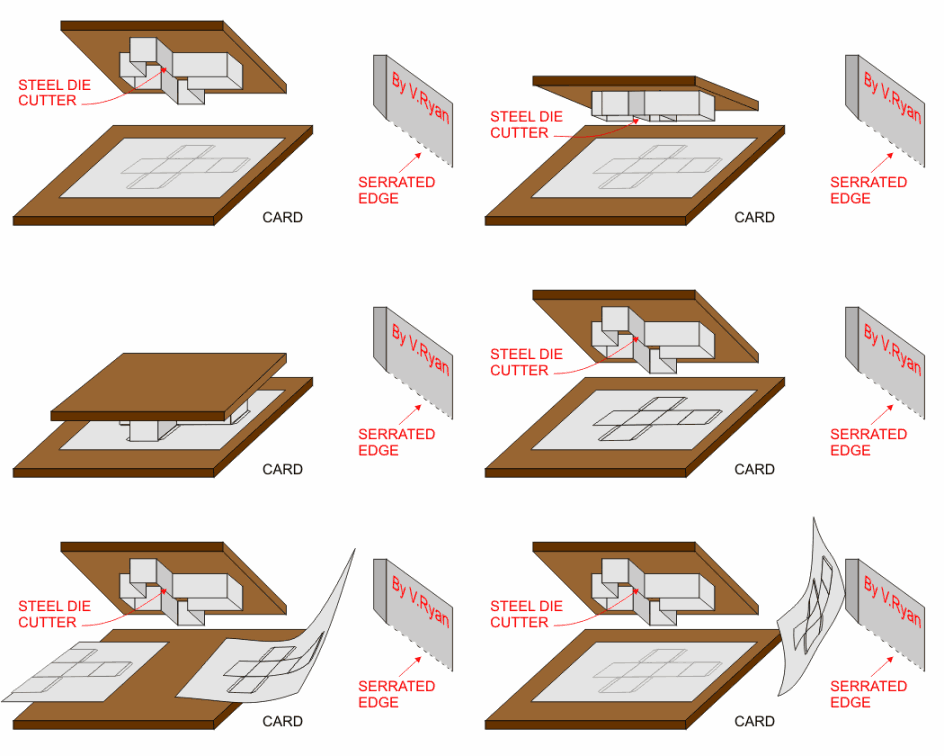
Think of this like a giant cookie cutter that you press into the material that you want to make specific custom packaging from. The technological advancements in this allowed for effective and easy designs for these boxes. So let’s take this example. First thing you do is make a packaging outline that’s made through computer aided design, and it allows for the drawings to be digitized directly onto the dieline, and then get transferred to a board that’s made out of wood. 

The dieline then gets burned into the surface of your board through the use of a laser cutter that’s accurate and offers great outlines as well. Basically, they map out everything and give the exact cut and fold lines, the bleed lines, along with the safe zones, in order to properly map this out before you move on with the actual cutting process of this too! 

This is pretty simple, and it allows for better accuracy. The die boards will sit below the material during this process, and then, it offers exact and accurate precision here. basically, the die boards are a guideline for the blade that lets it go through the material in a correct manner, allowing the cuts to be accurate and straight. This also offers a variety of different types of ways to make this work, including the following: 

  • Thorough cutting directly through your material 
  • Scoring which leaves an indent, impression, and partial cut. 
  • Creasing which makes a fold for really good construction. 
  • Perforating which makes it easy for you to tear. 

This has a lot of different types of benefits of materials and designs. 

This process is wonderful for corrugated packaging, including the construction and use of this, to make it even better and to make it simpler for you too. 

Is Your Biodegradable Stretch Film Recyclable 

This is something that’s become super popular, and with biodegradable stretch film increasing in the popularity, a lot of people are beginning to learn it, becoming intrigued, and learning so much more. With more and more people encouraging the green movement, a lot of companies are pushing for the degradable and plant based packaging, in order to offer sustainability, and also offering less of a bad impact on the world around you. So, it is something that people are curious about.  Is stretch film thats biodegradable able to be recycled? Here’s the answer! 

So Is It? 

This is ultimately based on different types of protocols. Ultimately, it does depend. Some of them are biodegradable, others not so much.  Some of them have certain protocols for disposal for you to consider.

What Types are Recyclable Then? 

Well, there are some that do this. Steelflex BIO Biodegradable stretch film for instance, is one that’s definitely all recyclable.  This does fully biodegrade five years even less, and is composed of some linear low-density kind of polyethylene, along with that also has a P-LIFE addition to this, which is basically an additive made with oil from palm trees and in turn, is the component that gives it biodegradable properties.

The cool thing about this one, is that if you decide to recycle the LLDPE types of film, now is the time! however, you should take a look at the current recycling protocols, since some of them aren’t good for being thrown into the single-stream bins, and might require another method of disposal.

How to Do It? 

This is ultimately dependent on the types of recycling that are availible to you, and what they can offer. There are some that are good for using single-stream types of disposal, so you’ll be able to toss this in a bin and go from there. But, a lot of them do not offer this. That’s why it’s important if, if you’re interested in recycling, you contact the company, and find out if they can help you. 

Some places may not be able to do so, and you might think it’s the end of that, but alas, that’s not the case!  There are third-party companies that recycle certain types of biodegradable stretch film.  Most of the time you’ll have to pay, but not in every single instance. Actually some of the companies that offer this pay you instead for the waste and used film, but there are some stipulations for you to consider.

You do need to make sure that you reach the minimums for this, so have that in place. If you did get compensated this, you also need to make sure that, in order to qualify, you bale everything together, and have it there before it all gets picked up.  If you don’t properly bale this, it’ll disqualify the possibility of getting paid to do this, o make sure that it’s done.

You also should look at wht the volume minimums are for anything that’s sorted and then later baled. Once that information is there, you can make the decision on what to do, and f you want to recycle your stretch film, you can start today, provided that you do have the right amounts, and you also sort and bale this, and ensure that it’s different from the other kinds of materials that you have sitting around.

So to answer the question of if you can do this, it’s ultimately up to you, and the needs that you have. the right types of recycling that are used do vary, so be smart and mindful before you decide to recycle this. 

Impact Of Damaged Products On The Planet

You may remember Earth Day celebrated by your school. On this day, children are taught to plant trees and given lectures about reducing, reusing, and recycling. While most of us remember these activities, it is unfortunate that we have been unable to evolve our understanding of sustainability beyond these activities.

Recycling today has become more complicated than ever, thanks to the production of large amounts of packaging materials that end up in landfills. While recycling facilities are working and new ones are being set up, they are unable to provide a quick remedy to the alarming situation.

With the packaging materials becoming more complex due to their compositions, the recycling requirements have also increased quite a bit. Every packaging material comes with its specific recycling instructions, some of which may not be understandable for most consumers.

The average contamination rate of recyclable packaging supplies is 25%, which means that one in every four packaging products sitting in a recycle bin is not recyclable due to contamination. Accumulation of a lot of contaminated recyclable products can be quite detrimental to the recycling economy.

While most e-commerce consumers now prefer recyclable and sustainable packaging materials, the path to perfection is still not clear.

A more inclusive perception of sustainability

The arrival of a damaged product has become a fairly common instance in the e-commerce world. A more prompt brand would send another product immediately, asking the customer to throw away the damaged one.

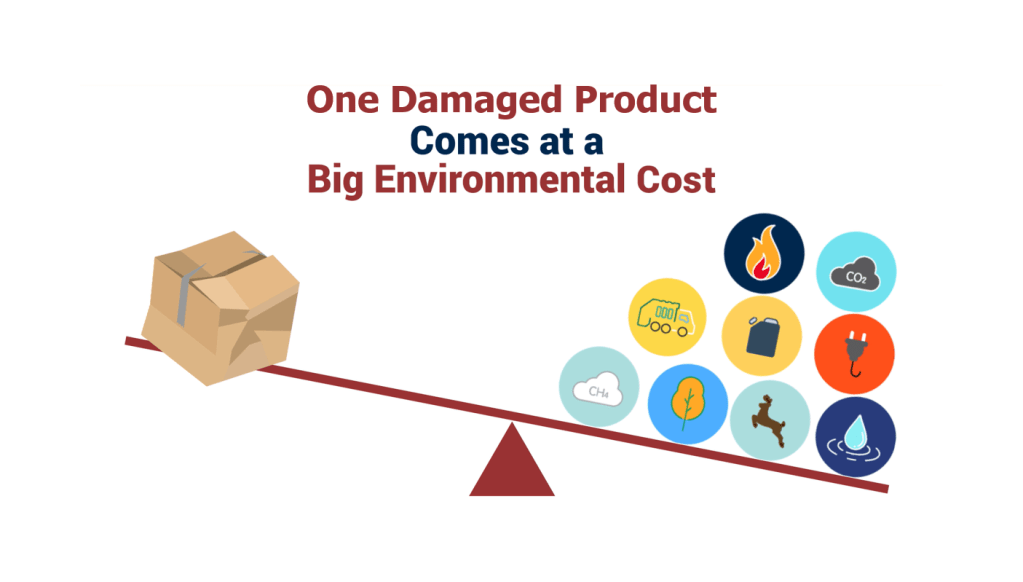
While such instances are undoubtedly undesirable for brands, the larger impact is on the environment due to a considerable amount of waste. The delivery of a damaged item means the product, along with its packaging, going into the trash.

Damaging effects to the planet

While damaged products and packaging are not welcomed anywhere, a lot of products get damaged during shipping. With e-commerce prevailing with every passing day, the instances of product damages are increasing significantly. Furthermore, the concept of product returns has also resulted in a rise in packaging wastes. Consumers, who do not like a product upon delivery, opt to send it back to the manufacturer, throwing its packaging into the trash can.

Wastes due to damaged or returned products are not limited to the packaging supplies only. Every e-commerce product has to travel to its consumer in the first place, which means that it has to be manufactured, stored, packaged, and transported before it reached its destination. Each of these steps results in some form of emissions or energy consumption. That means the environmental impact of the entire supply chain process is more significant than we can imagine. And then product damage or return adds more to this impact and that too quite significantly.

What does all this mean? Well, it means that every product packaging decision has an impact on the environment. That is why it is necessary to be mindful of each step involved in the supply chain. While packaging products, make sure to use enough packaging supplies to protect your product during shipping. However, be sure not to go for overkill. Work on the dimensional weight of all of your packages to keep costs and fuel consumption under control.

What Foil Stamping Is 

Foil stamping is something that utilizes heat, metal dies, along with pressure, in order to offer a chance to make foil films This is used in a ton of applications, including: 

  • Stationary and notepads 
  • Labels 
  • Cards 
  • Seals 
  • Packaging for products 
  • Postcards 
  • Pocket folders 
  • Certificates 

This is a modern kind of technique that was first found during the late 19th century, and these days, it creates a very interesting, visualized interest, and also offers a better, more perceived view of the products that are there. The foil is very thin, and it’s coated with different colors, applied directly through processes that are called hot stamping

The pigment is then placed directly onto the clear film, which is then used as a carrier, and then transfers this color directly onto the product at hand. There is another layer of this, which is then consisted of the different sediments, and then, on the third layer, there is an adhesive that’s heat-activated in order to stick this directly onto the product. 

This works well on a lot of different types of paper stocks, and it works as well for finishes that are smoothed, and even too, when compared to textured, or very lined kinds of materials too. 

The Types of Stamping 

This is all ultimately based on your substrate and the finish you’re going for. 

There are different hot stamping techniques, and we’ve listed a few of them below: 

  • Vertical foil: this stamps the foil designs onto cylinders, and also flat substrates 
  • Flat foil: this is simple, where you use magnesium, or copper, and the metal stamp then transfers directly onto this substrate, offering a foil design that definitely raises directly onto the surface 
  • Sculped which uses a brass die in order to offer a raised image that’s defined, and curved 
  • Peripheral foil: the heat then transfers applied directly towards the outer perimeter of your product directly 

Normally, gold and silver is the best way to offer a luxurious color to this as well. 

The different finishes, including matte, glossy, holographic, and metallic or even wood grains can be used. 

The Benefits 

The benefits is definitely obvious whenever you’re trying to really make a design sign. 

Foils that are light or metallic are great for anything that’s dark, as it makes it very easy for you to read 

You also can get a range of different finishes via hot stamping, and it lets you experiment as well with the packaging and branding. 

The different striking elements that are possible through the use of this technique do stand out too amongst a giant sea of different products that are competitors. 

There are other kind of options to stamp too, and printing finish options, and that’s worth checking out. 

Foil stamping is one that a lot of people are looking to use, as it’s one that allows you to bring some new, amazing life to the packaging that’s there. whether you wnat to enhance the logo or the artwork on something, foil stamping makes your products look like they’re worth even more and are something with a higher value than what’s perceived. 

The process is all done with a machine, where the design gets etched, heated up, and then has a high pressure stamp to create a thin layer directly onto the substrate. 

This application is one that’s a very core amount, and it offers the correct result that’s there. 

You can make this out of copper, brass or magnesium. Although expensive, it’s worth it, especially if you use it a lot too. 

Dos and Don’ts of a Good Unboxing experience 

If you’re someone who wants to engage with customers on the products, you can build this through unboxing experiences. This is a great way to help create a wonderful impact and build a really great experience for the customers you have. How do you make it unforgettable though? What should you avoid? Here are a few things that you should do, and things you shouldn’t do, to create a peak unboxing experience you and your customers will love. 

What to do 

First, you want to use packaging that’s branded. After all, you’re getting customers to learn about you. You can include the brand and other aspects of this on all of the materials for packaging. Logos added to packaging are cheap, and the cool thing about it is that you can have the brand be there through the process of unboxing, and it can be done in a way that it’s not too much for customers either. 

The second thing is to get creative with the packaging. You want to make sure that you get a little different with it. Custom box inserts, paper tissue that’s branded, or recycled paper are good. You should also make sure that tape is also utilized too, as you’re already sealing this, and this does ensure a better, branded experience. 

It’s important though to make sure that you choose materials that do align with the identity of the brand, and the environmental ideas of this. This is something that does make it better for you, and you should get creative, but don’t make the unboxing experience bad. 

Third thing is you want to make it more than just good packaging. Thank-you notes and letters, free samples, coupon codes, or even free returning is a good option. This encourages customers to share, and they see from this, that you do give a darn about the experience that you’re trying to convey. 

What NOT To do 

Let’s talk about what you should not do with this. The first is you don’t want to get too crazy with the packaging. But wait, aren’t you supposed to use branded packaging? Of course, but you want something that’s not super complex, or something that comes in packaging that’s too complex for you to open up. 

Keep it simple, keep it aesthetic, and keep it easy for people to access. This makes the unboxing experience fun, but it also shows that you’re a sustainable company, as you’re trying to keep the carbon footprint that you have as low as possible. 

Second thing is get rid of the foam peanuts. Foam peanuts used to be the in thing for packaging, and it was something that you may want to use. But here’s the problem:” they are far from eco friendly, are annoying for cleaning, are really not that good, and let’s face it, they cling to just about everything. Get an alternative to the void filler for your own needs 

Finally, don’t waste the space. You should make sure that all of the space is utilized. Big, empty boxes are the last thing that you want, and people hate that stuff, so keep the space used, and try to get as much usage of this as possible. 

Unboxing is super fun, and it’s a great experience for many people. For a lot of them, the right unboxing experience does matter, so you’ll definitely want to, with this as well, choose items that benefit you, and be mindful of the packaging that you have, as it can make the experience that much better for you. 

Can you Add Reusable Packaging to Subscription Boxes 

Subscription boxes are growing in popularity, especially across many different industries. From beauty to fashion, to even food, there’s a whole lot of ways to utilize subscription boxes.

One thing that’s a problem for some users, however, is the packaging that’s wasteful and reduction of such. subscription services should consider different ways to reduce packaging waste. One option is reusable packaging, which we’ll go over here. 

What is Reusable Packaging 

Reusable packaging is a form of sustainable packaging where you can reuse the items, in order to give them another lifecycle.

Boxes that you can reuse, various jars that you can use once again. Even various packaging boxes that you can use in the future to ship things to others are considered these types of packaging.

Designed for usage and sustainability, There’s a lot of great benefits that come with reusable packaging, which we’ll go over here.

Elements of reusable Packaging 

Reusable packaging is made to be durable, as in the case of boxes. Corrugated boxes for instance, are one great example of this.

With reusable packaging, you can use this, and then return it.   In the case of subscription boxes, you might have a drop off point. They can also be refilled by customers to be used again.

Some people keep boxes so that they can use them to store items. This is especially true with moving, and aspects of that.

There’s also the repurpose aspects of this. If you have a box that’s nice, but you can use it for other activities, then great. A clothing box that can be repurposed into a hanger is one example of this.

Now, with reusable packaging, you want to make sure that the materials are eco friendly too. We said boxes, both corrugated and regular ones are a good start. Some may use bioplastics in their subscription product services. While it may cost a bit more, it does work.

Having dyes and inks that won’t bleed and will be sustainable for the planet is also good for you, because you can simply toss it away without feeling guilty in a lot of cases.

Having systems that are easy to return and systems that will allow you to just give back these items when done provides you with newfound ways to offer eco friendly services for people. 

The Benefits of This 

With this, you’re able to reduce the environmental impact that your items have. If you have a lot of customers that tend to focus on how green companies are, then you’ll want this.

It also builds brand experience and customer engagement, exciting them and enhancing the brand experience. Some customers might be more interested in working with you if they can see that you are sustainable. It might not seem like much, but it does the job, and really builds character. 

Considerations for this 

There are a few considerations that come with this.

The first is the cost of materials. Reusable ones tend to need to be more durable. Which guess what? That means you need to use more material. This can impact costs for some people, and also the different factors for a business.

You also need to look at the logistics for returns and reusing these items, because far too many people think you can just drop it off and call it a day. That is not necessarily the case.

Doing this and considering all of these factors offers better options for reusing the items, in order to create an enhanced brand experience, that will impact the design and functionality in many different ways as well. 

All About Foil Stamping 

Foil stamping is something that’s great for making sure that your product stands out. It is a type of printing that uses a die that’s made of metal, pressure and het, and a foil film that helps enhance a product.  There are a lot of applications of foil stamping, which include: 

  • Labels 
  • Stationery 
  • Cards for the holiday 
  • Packaging of products 
  • Folders with pockets 
  • Seals, certificates 
  • Postcards 

These days, it’s got a more modernized name to it, known as hot stamping. This was first made in the 19th century.  These days, it’s leveraged to build a visual interest, and increase the perceived value that products have. 

Foil is a thinly coated type of item, which has colors that are put through this, and that’s with the hot stamping process.  You add the pigment to a film that’s clear, and then, that color, along with the design, is then translated to the product that’s there. 

Another layer of this foil also might have other pigmentation. Finally, you’ve got a third layer of adhesive that’s activated by heat, and it sticks directly onto the product as well.  Like spot UV and embossing, you can apply all kinds of stamping using foil to paper products. 

It works best with some stock to create an even, smooth surface, rather than one that’s lined up or textured in terms of materials. 

Types of Stamping 

Based on the type of substrate you’re going for, there are a few different types of foil stamping that you can use. 

They are: 

  • Flat foil: this is an economical, simple process that uses magnesium or copper stamps that transfer this directly to the substrate. It achieves this with a small raise of the surface that’s there 
  • Vertica: this causes the design to fit well on substrates that are flat, or cylindrical 
  • Sculpted: this uses a die that’s made of brass to create a more raised look on a defined or carved area that really stands out
  • Peripheral: this is foil heat that’s applied to the outer circumference or perimeter of this product 

Gold is usually what’s used, but silver is another, used to create a more luxurious look.  There are also matte, glossy, holographic, and metallic types of sparkles and different wood grains that can be added to this.

Foil Types used 

There are different variants of foils that are used to create a more distinctive look to the products and packaging, especially if it aligns with the brand image or the marketing campaign of choice. 

There is metallic foil which has an attractive sort of patina that goes all the way across. While gold is usually used with metallic, there is also silver, red, blue, copper, and even green types. 

Matte pigment is one that’s more muted in the way that it’s used, but the color depth is something that you certainly can enjoy. 

Glossy pigment is where you combine the high gloss with a more non-metallic type of finish, across many different color variants. 

Holographic is where you add hologram sorts of features for an eye-catching, futuristic sort of look to the item that’s there. 

Finally, there is the special effects foil that is used to create a variety of different textures that are there, including mimicking pearl, leather, and even marble 

In general, the right type of foil that’s used for each job is ultimately based on the type of substrate that you’re working with, and also the colors that come with this. If you’re looking to really create impactful results, use these today! 

Creating DIY Individual Boxes for Cupcakes 

Are you someone who loves cupcakes and wants to create packaging that really sells them? Well, why not go DIY? DIY cupcake boxes are a quick, effective way to build cupcake boxes that you will love. You do need to first find the dimensions internally of the package. For instance, how much space you need for the cupcakes, the toppers, and any extra space.  You need to take your product, measure it, and also make sure to measure each cupcake, as there are different measurements for this.  you’ll be able to find the right type of sizes that’ll contain each of the sweets there, regardless of the variations of each.

Once this is set, you choose the shape of this DIY packaging that’s there.  There are tons of models which are basic and can be customized into both the graphic and the size in order to create a packaging that’s bespoke. 

Once the box type is chosen, then you need the internal dimensions of this.  you want to choose one based on the weight of the cupcake, and then there you go, it’s done.

From there, once you have the correct sizes and throw this in, then the application will automatically generate this dieline of each of the bespoke boxes, and you can also download some vector PDFs for you to use. 

This die-cut template is folded and cut into different 2D drawings of each of the boxes and is vital for creating the project graphics. 

Personalizing each of the PDFs with the artwork that’s there allows you to enter each of the logos, making this product attributable and recognizable.  Placing these decorative and informative elements where you wish will help you create attractive graphic designs in order to add value to each of the cupcakes. 

Once this layout is then ready, you just have to produce each of these boxes.  It’s great because with a whole bunch of these different sites to make these, they give you a chance to buy each of these different types of boxes that are printed which you need, especially for a singular type of packaging.

The optimal solutions are to launch new products, testing this market before you place orders that are larger. 

From there, you can put this out, and then see. If people love this, then there you go. You’ve got the solution necessary to create the best types of boxes that you can. If there are people who don’t like this, then you can start to change this as needed to fit the needs that you have.

Another thing that you can do in order to generate interest and to get a feel for what it is that you’re doing, is A/B testing.  For instance, put two designs up, and then ask people if they prefer A or B before they go into full production. You can even send out each of these packaging options based on this.

There are a lot of different ways for you to do this, but it’s best to test and perfect before you send out everything. That’s because, when you send this out, you need to make sure you’ve got everything in place, especially prior to beginning. Do this now, and you’ll be able to create inspirational designs that work wonders, and those that’ll really shine in every single way.

If you’re not sure where to begin, don’t fret. There are now new collections of different cupcakes that you can throw together, in order to be further inspired by the intricate and unique designs that are possible.